
Diabetic Neuropathy Treatment in Tinley Park: Non-Drug Options for Nerve Pain
If your feet burn at night, your hands tingle for no clear reason, or you feel like you’re walking on sandpaper — and you have diabetes — those symptoms have a name: diabetic peripheral neuropathy. And you’re far from alone.
National Institute of Neurological Disorders and Stroke (NINDS) reports that approximately 60 to 70 percent of people with diabetes have some form of neuropathy, making it one of the most common — and most disabling — complications of the disease. Most patients are handed a prescription and told to manage expectations. But that’s not the whole story.
At Health on Earth Chiropractic in Tinley Park, we take a root-cause approach to diabetic neuropathy — one that addresses why your nerves are deteriorating, not just how to quiet the pain signal. Here’s what you need to know.
Diabetic Neuropathy Treatment Tinley Park: Why High Blood Sugar Destroys Nerves
Nerve damage from diabetes doesn’t happen overnight. It’s the result of years of chronically elevated blood glucose slowly eroding the structures that keep your nerves alive and functioning.
When blood sugar stays high for extended periods, it damages the small blood vessels (capillaries) that supply oxygen and nutrients to peripheral nerves. Without adequate circulation, nerves begin to malfunction — and eventually die. The process also triggers oxidative stress and inflammation, two forces that accelerate the destruction of nerve fiber insulation (myelin) and disrupt the way electrical signals travel.
The National Institutes of Health (NIH) confirms that tight blood glucose control remains the most effective strategy for preventing and slowing the progression of diabetic neuropathy — which is why any meaningful treatment plan has to start with metabolic stabilization, not just symptom suppression.
The nerves most commonly affected are those in the feet and lower legs, which is why symptoms typically start from the ground up. Over time, the hands and arms can become involved as well.

Recognizing the Symptoms: What Diabetic Nerve Damage Actually Feels Like
Diabetic peripheral neuropathy doesn’t present the same way in every patient. The symptoms vary depending on which nerve fibers are affected — sensory, motor, or autonomic — and how advanced the damage is.
Common sensory symptoms include:
- Burning or stabbing pain in the feet or hands, often worse at night
- Tingling or “pins and needles” sensations
- Numbness or reduced ability to feel temperature and touch
- Electric shock-like jolts in the legs or feet
- Hypersensitivity — even a light bedsheet touching your feet can feel painful
Motor nerve involvement can cause muscle weakness, difficulty walking, or loss of coordination. Autonomic nerve damage — less discussed but equally serious — can affect digestion, heart rate, and bladder function.
The danger with numbness in particular is a loss of protective sensation. Patients who can’t feel injury to their feet are at significantly higher risk for ulcers, infections, and in severe cases, amputation. This is not a condition to wait out.
| Nerve Type Affected | Common Symptoms | Where You Feel It |
|---|---|---|
| Sensory Nerves | Burning, tingling, numbness, pain | Feet, legs, hands, arms |
| Motor Nerves | Muscle weakness, balance problems, foot drop | Legs, feet, hands |
| Autonomic Nerves | Digestive issues, bladder dysfunction, heart rate changes | Internal organs, sweat glands |
Why Medication Alone Often Isn’t Enough
The standard medical approach to diabetic neuropathy typically involves prescription medications — gabapentin, pregabalin (Lyrica), duloxetine (Cymbalta), or tricyclic antidepressants. These drugs can take the edge off the pain for some patients. But they don’t repair nerve tissue. They don’t improve circulation to damaged nerves. And they come with significant side effects including dizziness, weight gain, cognitive fog, and dependency concerns.
The CDC reports that 38.4 million Americans have diabetes as of 2023 — the majority of whom are at risk for developing peripheral neuropathy over time. With numbers that large, and medication providing limited long-term relief, there’s a critical need for approaches that actually address the underlying damage.
The Mayo Clinic identifies lifestyle-based and non-pharmacological approaches — including physical therapy, transcutaneous electrical nerve stimulation (TENS), and blood sugar management — as important components of diabetic neuropathy treatment. In other words, even conventional medicine acknowledges that drugs alone aren’t the answer.
Many patients in Tinley Park come to us after years on medications that only partially worked — and they’re frustrated, exhausted, and ready for something different. That’s where our functional medicine and targeted neuropathy protocols come in.
The Functional Medicine Approach to Nerve Damage at Health on Earth
Functional medicine asks a different question than conventional care. Instead of “what drug matches this symptom?” it asks “why are these nerves failing, and what does the body need to stop the damage and begin recovery?” At Health on Earth Chiropractic, our neuropathy treatment program is built around that question.
Blood Sugar Stabilization: Because chronic hyperglycemia is the root driver of nerve damage, getting blood sugar under control is non-negotiable. We work with patients on dietary protocols designed to reduce glucose spikes, improve insulin sensitivity, and lower systemic inflammation — without relying solely on pharmaceuticals. This isn’t just about A1C numbers. It’s about removing the daily assault on nerve tissue.
Anti-Inflammatory Nutrition: Inflammation is a key mechanism in neuropathic nerve damage. We use evidence-informed nutritional protocols — including anti-inflammatory dietary shifts, omega-3 fatty acid support, and elimination of common inflammatory triggers — to reduce the biochemical environment that accelerates nerve deterioration.
B12 and Alpha Lipoic Acid Support: Vitamin B12 deficiency — common in people taking metformin for diabetes — directly impairs myelin production and nerve repair. Alpha lipoic acid (ALA) is a powerful antioxidant that has been studied extensively for its role in reducing oxidative stress in peripheral nerves. Multiple clinical studies have found ALA supplementation significantly reduces neuropathic pain scores and improves nerve conduction. These are not fringe supplements — they are supported by a substantial body of research and represent an important adjunct to any neuropathy care plan.
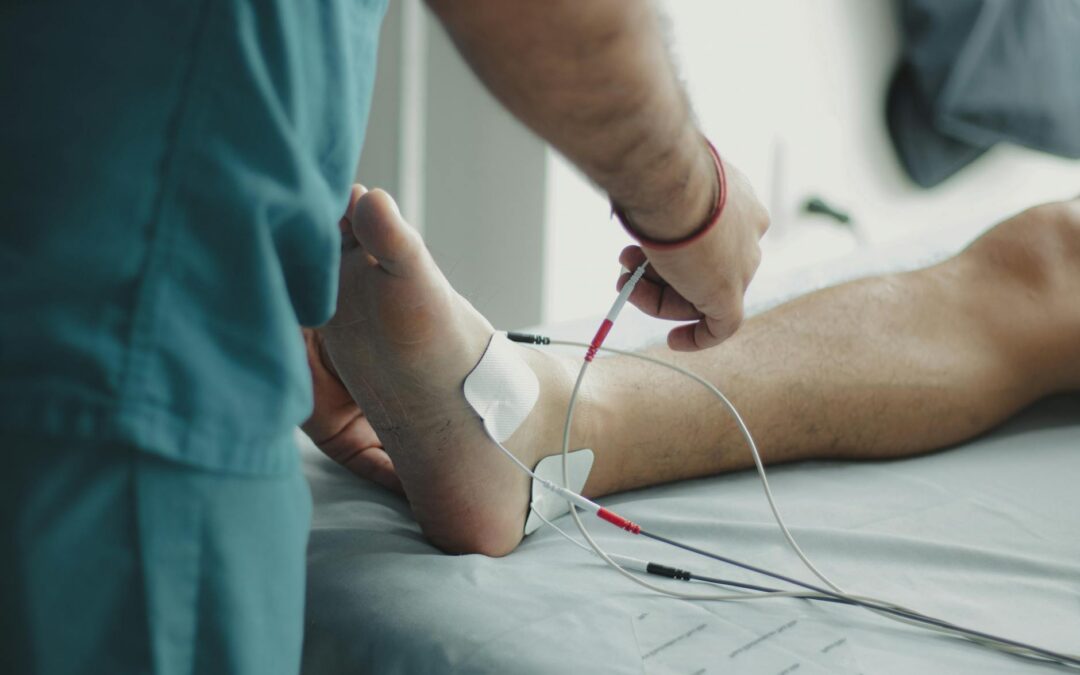
Targeted Neuropathy Therapies: Beyond nutrition and supplementation, we use in-office therapies specifically selected for peripheral nerve recovery. These include low-level laser therapy (photobiomodulation), which has demonstrated the ability to stimulate mitochondrial activity in nerve cells; electrical nerve stimulation modalities that improve circulation and nerve signal conduction; and vibration therapy to retrain sensory pathways. Research published in the Journal of Manipulative and Physiological Therapeutics indicates that chiropractic care and physical modalities may help reduce pain and improve function in patients with peripheral neuropathy.
For patients whose neuropathy is compounded by spinal involvement — where nerve compression in the lumbar spine worsens symptoms in the legs and feet — our non-surgical spinal decompression therapy can relieve that additional layer of nerve pressure. It’s not uncommon for patients to have both diabetic nerve damage and a compressed spinal nerve contributing to their leg symptoms. Treating only one will produce incomplete results.
What Realistic Outcomes Look Like — and How We Monitor Progress
We want to be honest with you: diabetic neuropathy is a serious condition, and recovery depends on many factors — how long you’ve had it, how well your blood sugar is controlled, your overall health, and how consistently you follow the care plan. We’re not promising miracles. We’re promising a thorough, individualized approach that many patients never received before walking through our door.
Many patients report meaningful improvement in pain levels, sleep quality, and sensation within 8 to 12 weeks of consistent care. Others experience a stabilization of symptoms — preventing further deterioration — which is itself a significant clinical win. Our goal is always to restore as much nerve function as possible while protecting the tissue that remains.
We monitor progress through functional assessments including sensation testing, balance evaluation, and patient-reported outcome measures. As blood sugar stabilizes and inflammation decreases, we adjust the care plan accordingly. This is not a one-size protocol — it’s individualized care that evolves with your response.
It’s also worth noting: if you’re experiencing leg pain that has a sharp, shooting quality traveling from your lower back down through your hip and leg, that may also indicate sciatica — a separate but sometimes overlapping condition that we also treat non-surgically. Getting an accurate diagnosis is the essential first step, which is why our new patient exam is so thorough.
Patients dealing with related concerns like back and neck pain often find that addressing spinal health as part of a comprehensive care plan accelerates their overall recovery — particularly when nerve symptoms in the extremities have a musculoskeletal component layered on top of the metabolic cause.
You Don’t Have to Keep Living with Burning Feet
Diabetic neuropathy is progressive — meaning the longer it goes untreated or undertreated, the harder it becomes to reverse. But “undertreated” doesn’t mean you haven’t taken medication. It means the root causes haven’t been addressed. There’s a difference, and that difference is why so many patients with diabetic neuropathy in Tinley Park are still suffering years into their diagnosis.
You deserve a care team that will actually look at what’s driving your nerve damage, create a plan specific to your situation, and walk with you through recovery. That’s what we do at Health on Earth Chiropractic — and we’d love the opportunity to help you.
Ready to take the first step? Book a new patient exam at Health on Earth Chiropractic in Tinley Park today. Our team will conduct a comprehensive evaluation, review your history, and develop a personalized plan for your neuropathy care — no surgery, no pressure, just real answers. Call us or schedule online. Relief may be closer than you think.